

Apple fixed it in 2024. Attackers are using it now.
CISA flags exploitation of Apple flaw CVE-2024-27834; fixes have been available since 2024
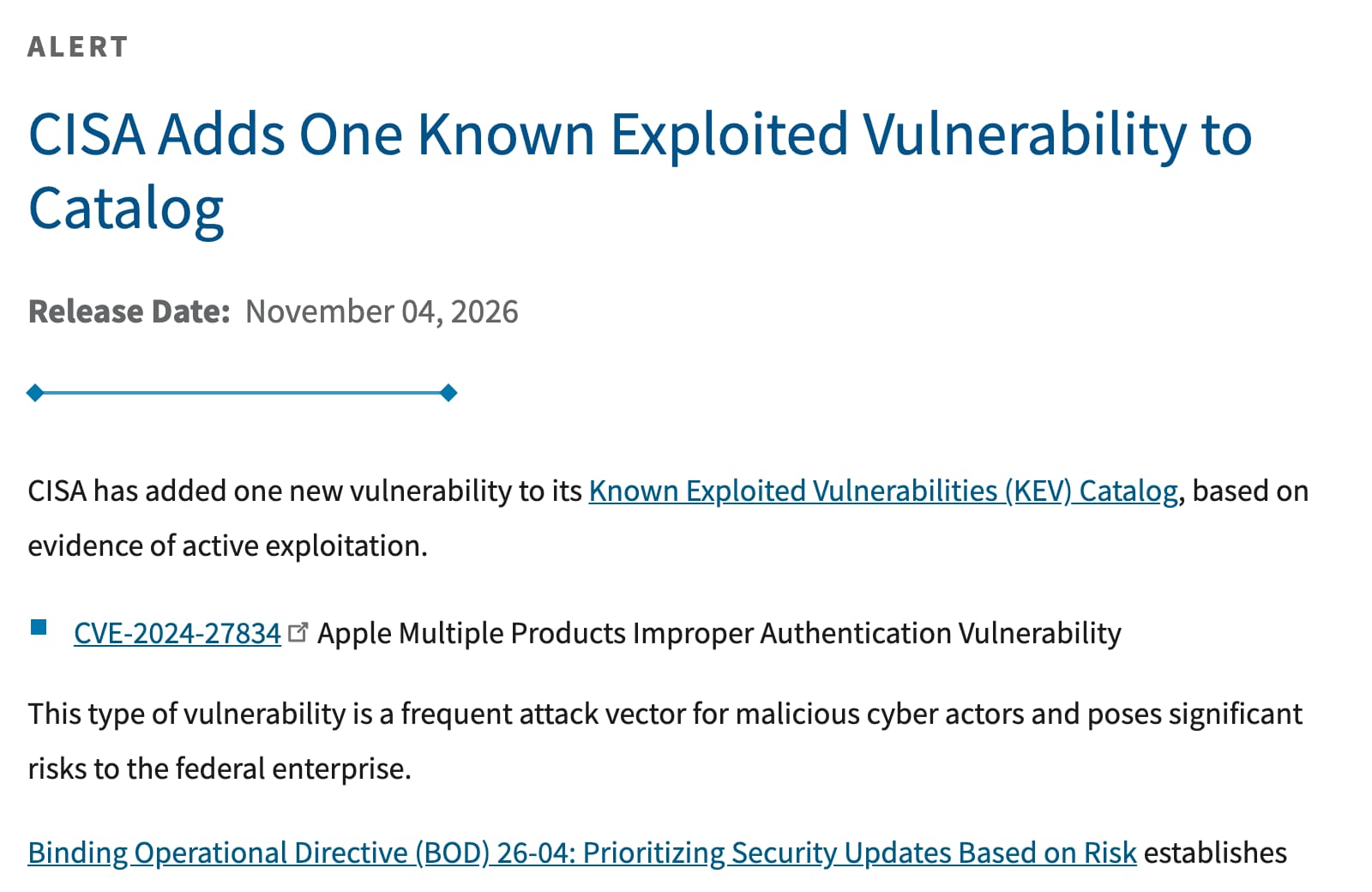
The Hacker News reports that CISA added CVE-2024-27834 to its exploited-vulnerability catalogue on 4 November. Sekoia found it used alongside another flaw to steal cookies from older iPhones. Apple’s advisories document fixes for iPhones, iPads, Macs, Apple Watches and Apple TVs.
What to do today
- Update your iPhone and iPad.Back up first, connect to power and Wi-Fi, then open Settings → General → Software Update. Install the latest update offered. Apple’s instructions[9] also explain how to update using a computer if needed.
- Check the Mac, including Safari.Open Apple menu → System Settings → General → Software Update, or search for Software Update using Spotlight. Install available updates and allow the installation to finish. Apple’s Mac guide[10] explains the process.
- Include the devices you manage for someone else.Check a parent’s phone, the spare iPad, and any Apple Watch or Apple TV. For work devices, ask the person responsible to confirm the installed software version and update status.
- Turn on automatic installation.On iPhone and iPad, open Settings → General → Software Update → Automatic Updates and enable automatic installation. Leave devices charging and connected to Wi-Fi overnight so updates can install.
What happened
If you look after the family’s Apple devices, check their updates today. On 4 November, the US cybersecurity agency CISA added CVE-2024-27834 to its catalogue of vulnerabilities used in real attacks, according to The Hacker News[1]. Apple released fixes in May 2024.
The flaw affects WebKit, Apple’s web-content software. Apple says an attacker who already has the ability to read and change memory could use it to bypass a security protection called Pointer Authentication. That prerequisite matters: this flaw is one part of an attack, rather than a complete route into a device by itself. Apple’s advisory[2] records the fix in iOS and iPadOS 17.5.
- HARD alert level
- High Install available updates
- iPhone and iPad fixes
- iOS and iPadOS 16.7.8; iOS and iPadOS 17.5
- Mac fixes
- macOS Sonoma 14.5; Safari 17.5 for macOS Monterey and Ventura
- Watch and TV fixes
- watchOS 10.5; tvOS 17.5
- Original release date
- 13 May 2024
The full story2 more sections
Who is affected
The devices to check are those still running affected software without the fix. Apple supplied iOS 16.7.8 and iPadOS 16.7.8[3] for the iPhone 8, 8 Plus and X, the fifth-generation iPad, and the original 9.7-inch and 12.9-inch iPad Pro. Its 17.5 update[2] covered iPhone XS and later and compatible newer iPads.
For Macs, Apple documented the fix in macOS Sonoma 14.5[4] and separately in Safari 17.5 for Monterey and Ventura[5]. It also included fixes in watchOS 10.5 for Apple Watch Series 4 and later[6] and tvOS 17.5 for Apple TV HD and all Apple TV 4K models[7].
Being covered by an advisory does not establish that every device type was attacked. Sekoia’s specific finding involving this flaw concerns older iPhones.
What the attacks can take
Security researchers at Sekoia[8] describe a campaign using compromised websites and imitation sites to reach mobile devices. One attack combines this Apple flaw with another vulnerability to steal cookies. Those cookies can potentially let an intruder reuse a signed-in session, including access to webmail.
Sekoia says the attack chains it analysed do not work against fully updated devices. The practical response is to install current updates, rather than stop at the original 2024 fix.
Timeline
-
HARD publishes its article, at High.
After the news
- How to update every device phones, computers, browsers, TVs and routers
References11
- ^ The Hacker News (). “Hackers Exploit Patched Apple Flaw to Deliver Info-Stealing Malware, CISA Says”. Reports CISA’s 4 November catalogue addition; contains a duplicated CVE identifier in its chain description.
- ^ Apple. “About the security content of iOS 17.5 and iPadOS 17.5”. Confirms the WebKit flaw, prerequisite, affected device coverage and fix released on 13 May 2024.
- ^ Apple (). “About the security content of iOS 16.7.8 and iPadOS 16.7.8”. Confirms the older-device fix and supported models; the software release date is 13 May 2024.
- ^ Apple. “About the security content of macOS Sonoma 14.5”. Confirms the Sonoma fix released on 13 May 2024.
- ^ Apple (). “About the security content of Safari 17.5”. Confirms the Safari fix for Monterey and Ventura, released on 13 May 2024.
- ^ Apple. “About the security content of watchOS 10.5”. Confirms the fix for Apple Watch Series 4 and later, released on 13 May 2024.
- ^ Apple (). “About the security content of tvOS 17.5”. Confirms the fix for Apple TV HD and all Apple TV 4K models, released on 13 May 2024.
- ^ Sekoia (). “Poisoned Source: APT29 watering holes target mobile devices with n-day exploits”. Primary research identifies CVE-2024-27834 in an older-iPhone cookie-theft chain and says fully updated devices resist the analysed chains.
- ^ Apple (). “Update your iPhone or iPad”. Supports the update path, backup advice, power and Wi-Fi requirements, and automatic installation.
- ^ Apple (). “Update macOS on Mac”. Supports installing the latest compatible Mac software, including Safari, through Software Update.
- CISA (). “CISA Adds One Known Exploited Vulnerability to Catalog”. Newsdesk supplied the feed summary; direct retrieval returned HTTP 403. The catalogue addition is attributed to The Hacker News pending editor verification.
Situation Room articles are updated as events develop: updates are added to the timeline, and never edited away. Follow them by email or RSS.