

Rakuten Securities test system leak: up to 11 million accounts
Rakuten Securities: up to 11 million account IDs may have leaked from a test system
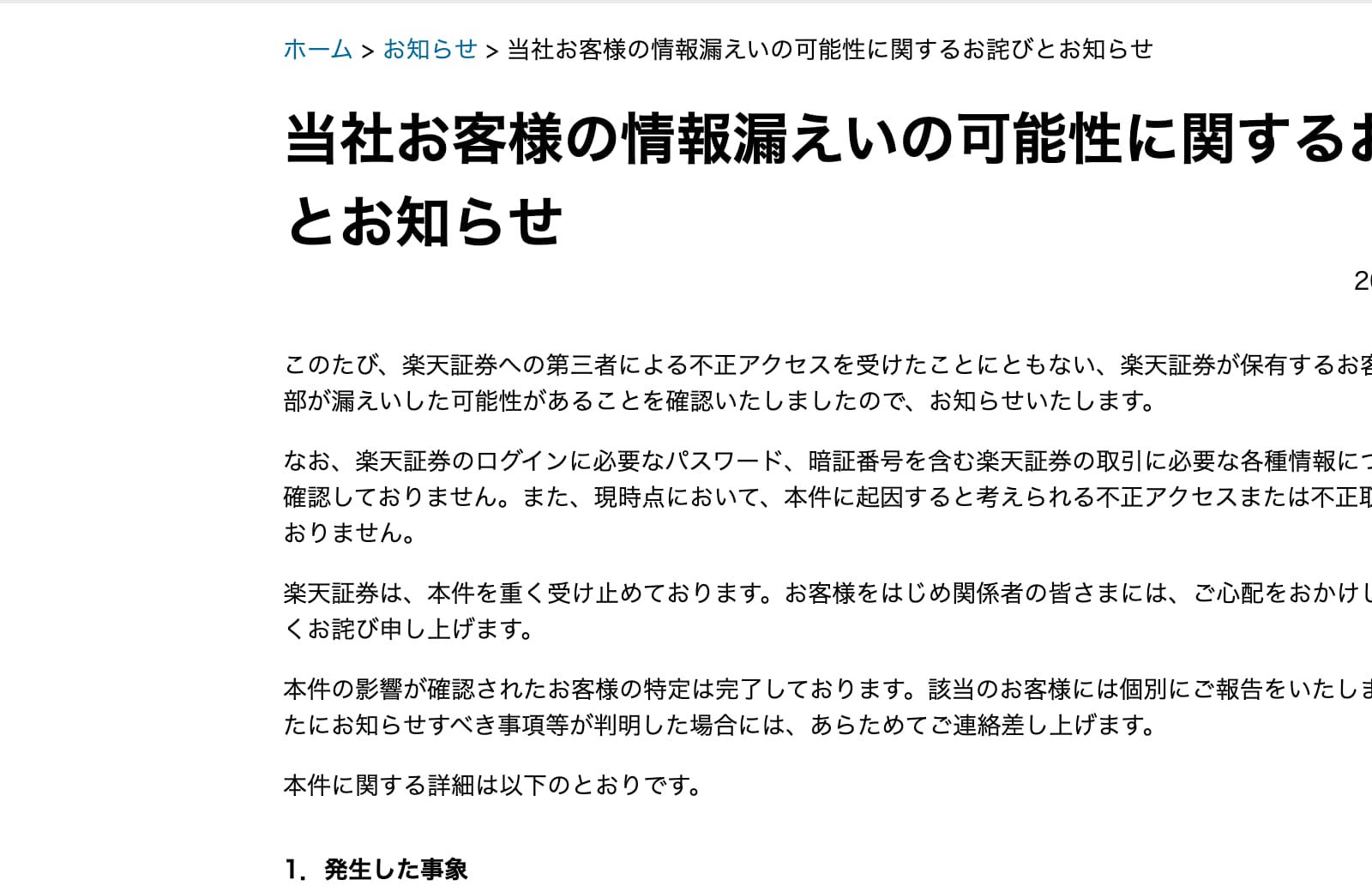
Rakuten Securities, a Japanese online broker, says some customer data held in a test system may have leaked after an intrusion into some of its systems. Up to about 11.25 million accounts may have had their login IDs exposed, and up to about 4.47 million also had personal and bank details exposed. The company has not confirmed any leaked passwords or unauthorised trades.
What to do this week
- Treat any message about this as suspicious.Rakuten says its emails contain no links, and it does not phone people to ask for personal or login details. If a message asks you to log in, go to the site by typing its address yourself. Don't follow links in it, and don't answer its questions.
- Set up passkey login.With a passkey, you sign in by unlocking your phone or computer with a face scan or fingerprint, so there is no password to type or steal. Rakuten says it is moving to make passkeys mandatory for login. Its notice links to a set-up guide.
- Use a password for this account that you don't use anywhere else.Rakuten's notice does not ask customers to change their password, because it has not confirmed that one leaked. If you use the same password on other sites, change it on those sites.
- Consider a temporary pause.If you won't trade or withdraw money for a while, Rakuten says the security settings page after login lets you suspend trading and withdrawals temporarily.
- If you are unsure, call the number on Rakuten's notice.The support line is 0120-862-274, open weekdays 8:30 to 17:00 and weekends 9:00 to 17:00. Use the number from the official notice, not one in a message you received.
What happened
Rakuten Securities says a third party got into some of its systems, and that customer information held in a test environment may have leaked. The company found the suspicious access on 16 November and made it public on 17 November. Up to about 11.25 million accounts may have had a customer code and login ID exposed. Up to about 4.47 million may also have had names, dates of birth, addresses, phone numbers, email addresses and withdrawal bank account details exposed.
- Severity
- High for account holders, current and former
- Disclosed
- 17 November 2026, by Rakuten Securities
- Login IDs and codes
- Up to about 11.25 million accounts
- Personal and bank details
- Up to about 4.47 million accounts
- Passwords and PINs
- Not confirmed leaked
- Unauthorised trades
- None confirmed as of 17 November
The company says it has not confirmed that any passwords or trading PINs leaked. It has also not confirmed any unauthorised logins or trades linked to this incident. The login ID in the data is different from a Rakuten ID, so it is not the one you use to sign in to other Rakuten services.
Here is the timeline the company gave. On 11 November, the information in the test system was found to have possibly leaked. On 16 November, Rakuten noticed possible unauthorised access to some systems and blocked it. It told the public on 17 November. The cause, and how the intruder got in, are still under investigation.
The full story2 more sections
Why real customer data was in a test system
Rakuten told ITmedia that it was upgrading an internal system and needed to check some functions against live data. It copied part of the live customer data to a test server for a set period. The company said test servers normally hold only dummy data, and called this a special case that followed its internal procedures.
Hiroaki Kuramochi, chief technology officer at the security firm Lac, told ITmedia that using customer data in tests is not standard. Test data should be dummy data, he said, and if real data is used it should be masked, meaning the personal details are hidden or replaced.
Who is affected
Anyone whose account information was in the test system. That includes people who have closed their Rakuten Securities account, because the company says former customers are in the data. The two groups differ. The larger group, up to 11.25 million accounts, had only the customer code and login ID. The smaller group, up to 4.47 million, also had the personal and financial details listed above.
The numbers are maximums, and the company says the data may have leaked, not that all of it did.
Timeline
-
HARD publishes its article, at High.
After the news
- Every data breach who was hacked, and how to check if you’re in one
- Data breach settlements the claims open now, by deadline
References3
- Rakuten Securities (). “当社お客様の情報漏えいの可能性に関するお詫びとお知らせ (Notice on possible leak of customer information)”. Official notice: detection and leak dates, account counts and data fields, former customers, passwords not confirmed leaked, no confirmed unauthorised trades, customer guidance, passkeys, support line.
- ITmedia (). “楽天証券漏えい、“テスト環境に顧客情報”のマズさ 識者「一般的でない」”. Rakuten's explanation of copying live data to a test server during a system upgrade, and expert comment from Lac CTO Hiroaki Kuramochi that this is not standard practice.
- Impress Watch. “楽天証券に不正アクセス 最大1125万口座の情報漏えい可能性”. Independent summary of the account counts, data fields, detection on 16 November and customer guidance; consistent with the official notice.
Situation Room articles are updated as events develop: updates are added to the timeline, and never edited away. Follow them by email or RSS.