

WordPress 7.1.5 fixes 20 core flaws, one that could lead to code execution
WordPress 7.1.5 fixes 20 core flaws, one of which could lead to code execution
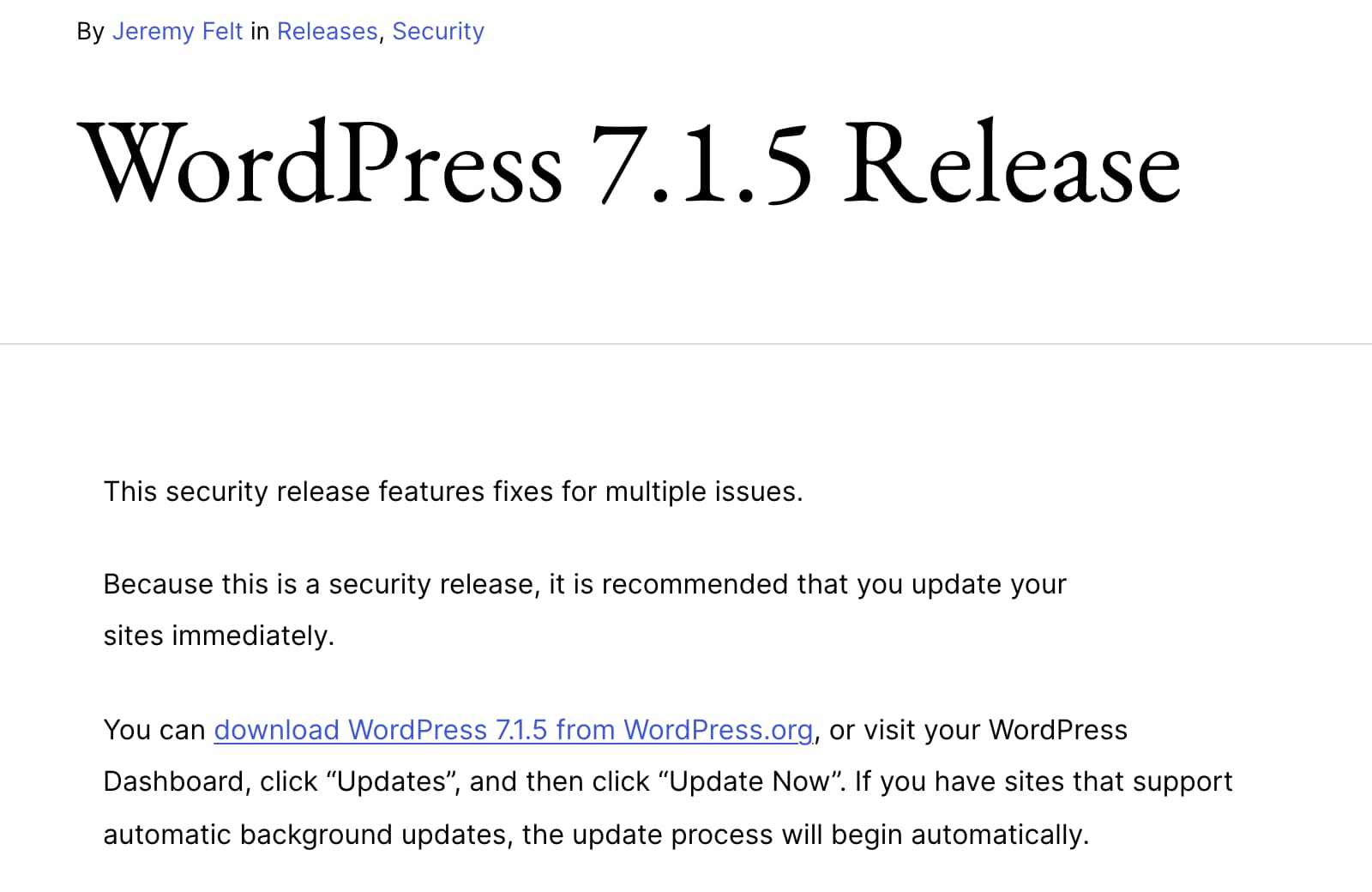
WordPress released version 7.1.5 on 18 November with fixes for 20 items in its core software. The most serious is an unauthenticated flaw in the Template Part block that WordPress says could lead to remote code execution, though that needs further steps.
What to do this week
- Update each WordPress site to 7.1.5.In the Dashboard, open Updates and choose Update Now. Or ask the host to do it, and check the version afterwards. Sites with automatic updates on need nothing more.
- If a site is on an older version, ask for a date.Ask the web designer or host in writing which WordPress version the site runs and whether the backported fix is in. Include CVE-2026-119977, fixed in 7.1.4. Versions 4.6 and earlier get no fix, so they need to move to a supported version.
- Check who has an account on the site.Remove accounts nobody uses, and check that each person has only the rights they need. Several of these flaws need a logged-in account, and an editor is the person who opens the crafted content.
- Treat update emails with care.Scam emails often say "urgent WordPress update, log in here". Update from the Dashboard, or go to wordpress.org by typing the address yourself.
What happened
WordPress 7.1.5 came out on 18 November. It fixes 20 items in WordPress core, the software that runs a WordPress site. Two of the 20 are hardening changes that Patchstack, a WordPress security firm, says have no exploitable path. The most serious is an unauthenticated flaw in the Template Part block, the editor tool that builds page layouts. WordPress says that flaw could lead to remote code execution, which means an attacker running their own commands on the server. That outcome needs further steps, so the flaw is not a sure route to takeover.
- Released
- 18 November 2026, by WordPress.org
- Severity
- High HARD's rating. WordPress gives no severity score.
- Fixed in
- WordPress 7.1.5. Older branches are still being patched.
- Exploitation
- None reported for the 7.1.5 bugs in the sources read for this story.
- Automatic updates
- Sites with background updates switched on receive 7.1.5 automatically.
The Template Part flaw needs no WordPress account. An attacker has to get crafted block code in front of an editor who opens that content. Patchstack says the route to running code then goes through an administrator's plugin-installation pages, using that administrator's own credentials. So an attacker gets further only where an administrator is involved.
The other fixes include several cross-site scripting bugs, where a page runs code hidden in a visitor's input, and SQL injection bugs, where crafted input is read as a database command. The release also fixes a Multisite flaw. On a network of WordPress sites run from one install, a site Administrator could take over a Super Admin account through the Customizer, the theme settings screen. WordPress lists no CVE IDs for these items.
Counts differ by source. WordPress lists 20 items. Patchstack counts 18 vulnerabilities plus the two hardening changes. Wordfence's headline says 19.
The full story2 more sections
Timeline
18 November. WordPress releases 7.1.5 and says sites should update immediately.
19 November. Wordfence publishes its write-up, which counts 19 vulnerabilities.
20 November.
A separate, older flaw is the one already under attack. CVE-2026-119977 is a race condition in WordPress core's update process, which can lead to code execution in complex attacks. WordPress fixed it in 7.1.4 on 28 October. CISA added it to its list of flaws known to be exploited on 3 November, and Wordfence said it blocked 13,095 attacks on it in one day. Sites on 7.1.5 already have that fix, because 7.1.5 is a later release on the same line.
Who is affected
Any site running WordPress core is in scope. That covers a business website, a club or school site, a personal blog, and a site built for a family member. If a web designer or host runs the site, they have to make the change, so ask them.
Sites with automatic background updates will get 7.1.5 without anyone doing anything. Sites updated by hand will not, until someone runs the update. Multisite networks should also check their list of administrators, because the Super Admin flaw reaches the whole network.
Older versions are in a worse position. WordPress says fixes are being backported to older branches that still get security work, back to 4.7, and that the backports are still in progress. Patchstack says branches 4.6 and earlier no longer get security updates at all. A site on one of those has no fix to install and needs to move to a supported version.
Timeline
-
HARD publishes its article, at High.
References4
- WordPress.org (). “WordPress 7.1.5 Security Release”. Release date, 20 listed security updates including two hardening changes, the Template Part and Multisite descriptions, update advice, automatic updates, and backports in progress through 4.7.
- Patchstack. “WordPress 7.1.5 Security Release”. Counts 18 vulnerabilities plus two hardening changes; Template Part attacker requirements and the admin plugin-installation route to code execution; no exploitation or public proof-of-concept mentioned; no CVE IDs at publication; branches 4.6 and earlier unsupported.
- BleepingComputer. “CISA flags WordPress RCE flaw as actively exploited in attacks”. CVE-2026-119977: race condition in core upgrade process, fixed in 7.1.4 (28 October), added to CISA's KEV catalog on 3 November, Wordfence blocked 13,095 attacks in 24 hours.
- Wordfence (). “WordPress 7.1.5 Security Release Fixes 19 Vulnerabilities”. Headline and feed summary: 19 vulnerabilities fixed in WordPress 7.1.5, released 18 November, site owners should update immediately. The full article could not be read.
Situation Room articles are updated as events develop: updates are added to the timeline, and never edited away. Follow them by email or RSS.