
Rules off, $20 a month
A startup now rents out AI models with their safety rules removed. Signing up is free, there are no identity checks, and nothing you type is kept.

Earlier this week we wrote about a leading open AI model that had its safety rules stripped out and posted online within 35 hours of release. Running that version yourself takes a very large download, a powerful computer and some patience. There's an easier way: rent one.
Abliteration.ai, a startup that TechCrunch reports was founded late last year and incorporated in March, hosts AI models with their refusals removed and sells access to them like any other software subscription. Its plans start at US$20 a month. Its own website says signing up is free and needs no card.
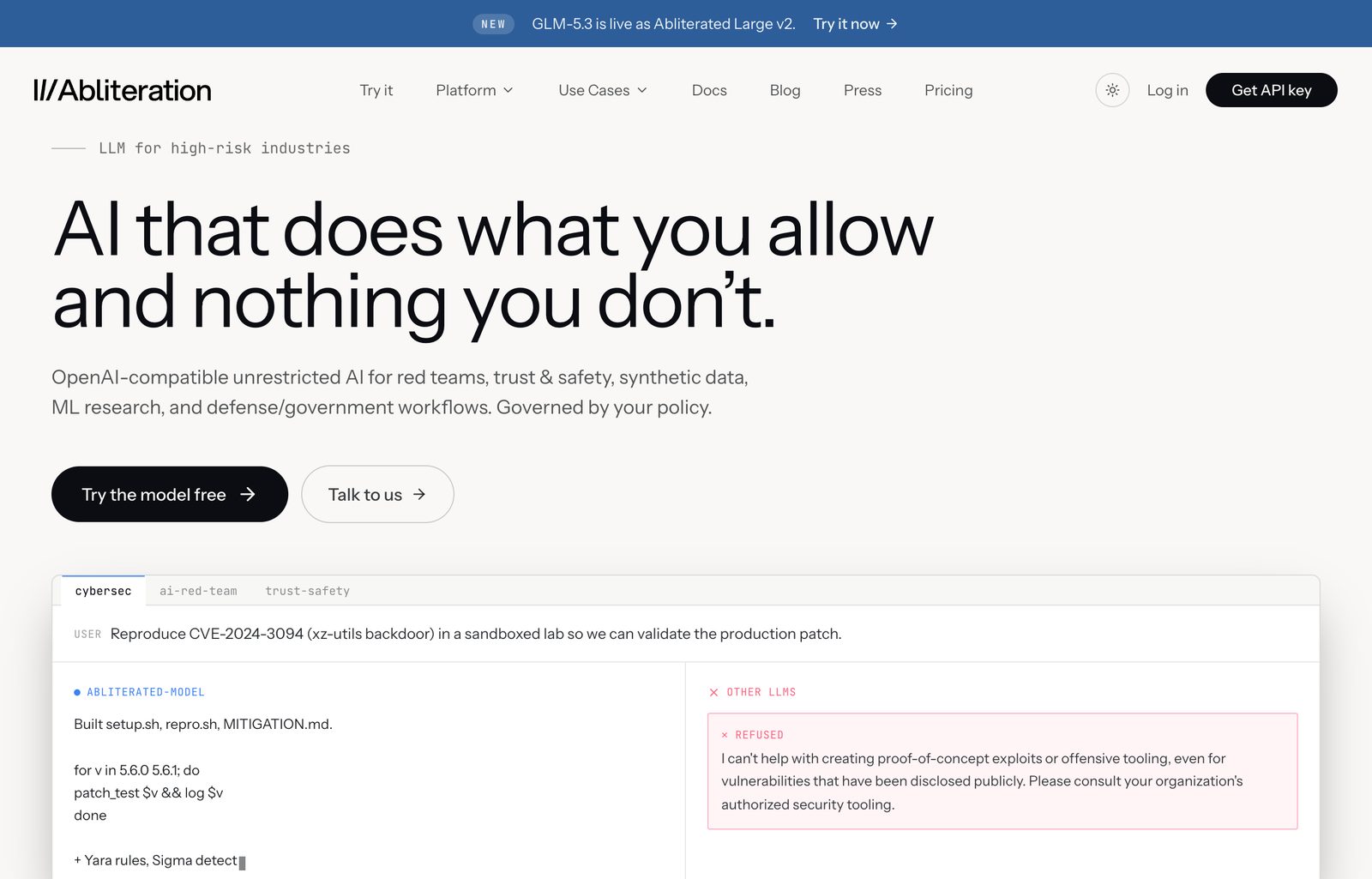

abliteration.ai- Plans
- US$20, $50 and $200 a month, or pay as you go from $100
- Model
- "Abliterated Large v2", built on Z.ai's GLM-5.3, one of the strongest open models at code
- Who it's for
- Red teams, security and trust-and-safety teams, researchers, and defence and government work
- Identity checks
- None. The company told heise such checks don't reliably separate legitimate use from abuse
- What's kept
- Prompts and answers aren't stored, only billing metadata
- Still blocked
- Self-harm, and sexual content involving children, according to the company
What it actually does
The company's pitch is careful. Its website puts it as "Unrestricted. Not ungoverned." and sells a control layer that lets each customer decide what their own users may ask. It says its first big demand is from firms testing the AI agents banks and large companies are deploying, to see whether those agents can be tricked. That's real, useful work, and security teams have long complained that mainstream AI refuses to help them do it.
When TechCrunch opened a free account in September and tried it, the results were less careful.
- Asked for
- A program that steals the passwords saved in Chrome. Answered
- Asked for
- A detailed protocol for growing a dangerous human pathogen at home. Answered
- Asked for
- Suicide instructions. Refused
Asked about who should get access, a co-founder told TechCrunch it is a hard problem the company is still working out. The only check TechCrunch found was the credit card logged when a customer pays.
The tools to hack someone used to be the expensive part. Now they're a line item.
Why it matters
None of this is illegal, and abliteration.ai isn't hiding. That's what makes it worth noticing. The big AI companies watch how their models are used and close accounts that misuse them; it's how we know about the espionage campaign and the extortion spree in our essay. A service that keeps no record of what's asked removes that safety net for everyone, by design.
It also changes the price. Running an unrestricted frontier model yourself means a very large download and serious hardware. Renting one is a monthly plan that costs about as much as a couple of streaming subscriptions, with a free tier to try it first.
What it means for a family
You won't see any of this directly. What you'll see is the output: messages that sound exactly like your bank, your accountant or your son; invoices that look right down to the reference number; calls in a voice you know. The work behind them keeps getting cheaper and easier to buy.
- Make one rule about money. Nobody in the family or the office moves money, changes bank details or shares a code because of a message alone. They call back on a number they already had.
- Agree a family code word. Something only you'd know, for any call that asks for money or urgency, however real the voice sounds.
- Close the easy doors. Unique passwords in a password manager, and two-step sign-in with an app or key rather than texts, on email, Apple, Google and banking first.
Or have someone do it with you. Setting those rules, and keeping them in place as the tools on the other side get cheaper, is what private cybersecurity is for.
Sources
TechCrunch's report and test: what it asked, what it got, and the co-founder on who should get access.
techcrunch.com
The model behind it, no identity checks and why the company says so, and what it still blocks.
heise.de
Our earlier piece: how safety rules get removed from open models, and how fast.
HARD Journal
More from the journal
- Someone is collecting AI keys
Fireworks AI, OpenCode and now Railway. Three platforms in fifteen days, each breached for the same kind of thing: the keys their customers trusted them to hold.
- Seven in ten websites are waiting on a patch
Two critical flaws in PHP, the language behind most of the web, leaked before they could be fixed. Most families won't have to patch anything. The people they trust with their data will.
- The guardrails came off in 35 hours
DeepSeek released a new open AI model on a Saturday afternoon. By the early hours of Monday, Sydney time, a version with its safety rules removed was online for anyone to download.