

The candidate’s voice could be a scam
FBI warns of AI candidate impersonation, fake donations and voter-registration scams
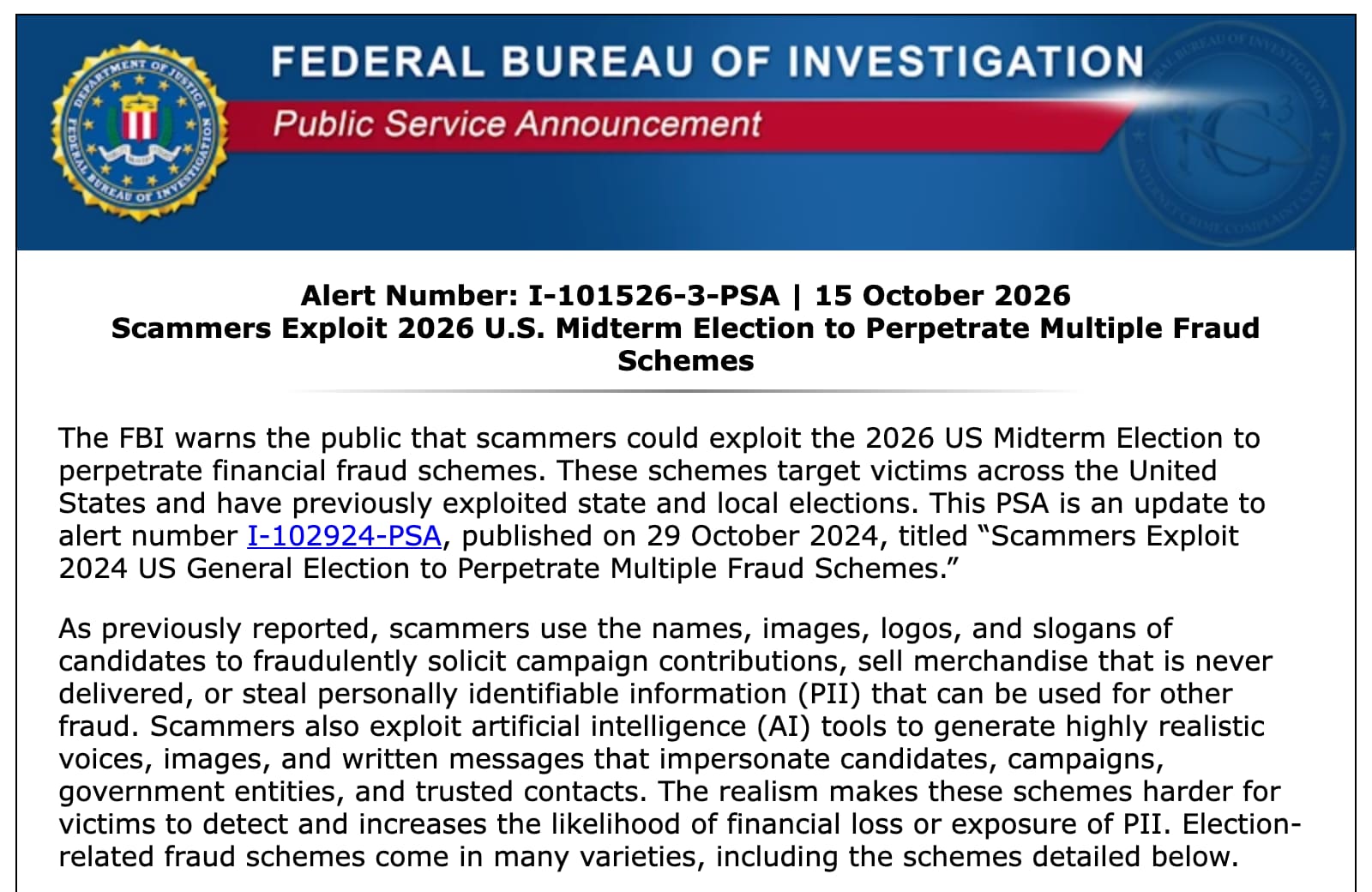
The 15 October advisory describes election scams that steal money and personal information. These include fake fundraising, undelivered merchandise and messages linking to imitation state voter-registration pages. It gives no victim count or total losses.
What to do this week
- Take a separate route to donate.Open a campaign website you have independently verified and use its donation route. Do not use an unsolicited caller’s payment instructions or a message’s link as your starting point.
- Check registration through the state.Type vote.gov into your browser, select your state or territory, and follow its registration-check route. Help parents save the official page as a bookmark.
- Act quickly if you paid.Contact your bank, card issuer or payment service immediately and ask whether the payment can be reversed or refunded. Use your banking app or the number on your card. The FTC’s recovery guidance[4] explains the steps for different payment methods; recovery is not guaranteed.
- Secure any details you handed over.If you disclosed a password, change it wherever you used it and turn on two-factor authentication. If you disclosed a Social Security number, follow the FTC’s linked identity-theft guidance. Report the election scam to the FBI through IC3, keeping the messages and transaction details for your report.
What happened
Before donating to a US election campaign or responding to a warning about your voter registration, open the official website yourself. In a 15 October advisory[1], the FBI warns that scammers use AI-generated voices, pictures and messages to impersonate candidates and other trusted identities.
One scheme starts with a text or email claiming you are not registered to vote. Its link leads to an imitation state registration page designed to collect personal information. Other scams solicit fake donations or sell campaign merchandise that never arrives.
- HARD level
- High
- At risk
- Money and personal details
- Registration check
- Start at vote.gov
- Donation check
- Verify the campaign and payment destination independently
The full story2 more sections
Who is affected
This warning concerns people targeted around US elections. For a family helping parents manage messages and payments, agree on a simple routine: check together before responding to an unexpected political request. Do not make recognising an artificial voice the test of whether to trust it.
For registration, Vote.gov directs you to your state’s election website[2]. Deadlines vary by state and territory. If your record needs attention, use the contact details on the official election site to ask what to do next.
Check where the donation goes
For a federal campaign or political action committee, the Federal Election Commission’s database[3] lets you look up candidates and committees, their filings, and how they raise and spend money. Use it as part of checking a request before paying.
Registration alone is no guarantee: the FBI cautions that scam political action committees can appear registered. Its advice is to examine their financial filings too. For a substantial donation, have the person who normally handles your family’s giving verify the recipient and payment details independently.
Timeline
-
HARD publishes its article, at High.
After the news
- Is this a scam? check a message, and every scam going round
References5
- ^ FBI Internet Crime Complaint Center (). “Scammers Exploit 2026 U.S. Midterm Election to Perpetrate Multiple Fraud Schemes”. Primary advisory describing AI impersonation, election fraud schemes, verification advice and reporting.
- ^ Vote.gov. “Register to vote in U.S. elections”. Official route to state registration checks; confirms that registration deadlines vary.
- ^ Federal Election Commission. “Campaign finance data”. Provides candidate and committee searches, financial information, filings and reports.
- ^ Federal Trade Commission. “What To Do if You Were Scammed”. Payment recovery, compromised-password and Social Security number guidance; page displays June 2026 without a day.
- Help Net Security (). “Scammers clone candidates’ voices to steal cash and voter data ahead of 2026 midterms, FBI warns”. Read as requested; postdates the draft’s 15 October cutoff and supplies no unique claim used in the copy.
Situation Room articles are updated as events develop: updates are added to the timeline, and never edited away. Follow them by email or RSS.