

Who else can read your AI chat?
Study: 21 of 42 chatbot websites sent conversation titles to outside trackers
Researchers tested 42 free chatbot websites in May 2026, from one US location. The authors say ChatGPT and Grok subsequently removed the implicated trackers.
What to do this week
- Remove identifying details first.Ask a general question without attaching the original medical letter, bank statement or legal correspondence. Replace names with placeholders and leave out addresses, account numbers and children's details. For advice that requires the full facts, use your established professional's agreed contact channel.
- Review marketing and training separately.In ChatGPT on the web, open Settings, then Data Controls. Use Marketing Privacy to opt out of sharing for targeted advertising where available. Review Improve the model for everyone separately if you do not want eligible conversations used for training. Follow the equivalent official guidance for other services.
- Reject optional tracking.Choose necessary cookies only where offered. Australia's personal cyber security handbook[5] recommends rejecting optional cookies and using a reputable ad blocker and privacy-focused browser. Keep limiting what you disclose even after changing these settings.
- Set a family and work rule.Help parents review their accounts and agree what should stay out of casual chatbot conversations. For executives, assistants and family-office staff, require approval before entering confidential work or client material. Ask the person responsible for technology which service and account are approved for that information.
What happened
Before pasting a parent's medical letter, a family dispute or a confidential business question into a chatbot, pause. Ask whether the service needs the identifying details, and whether you understand who can receive them.
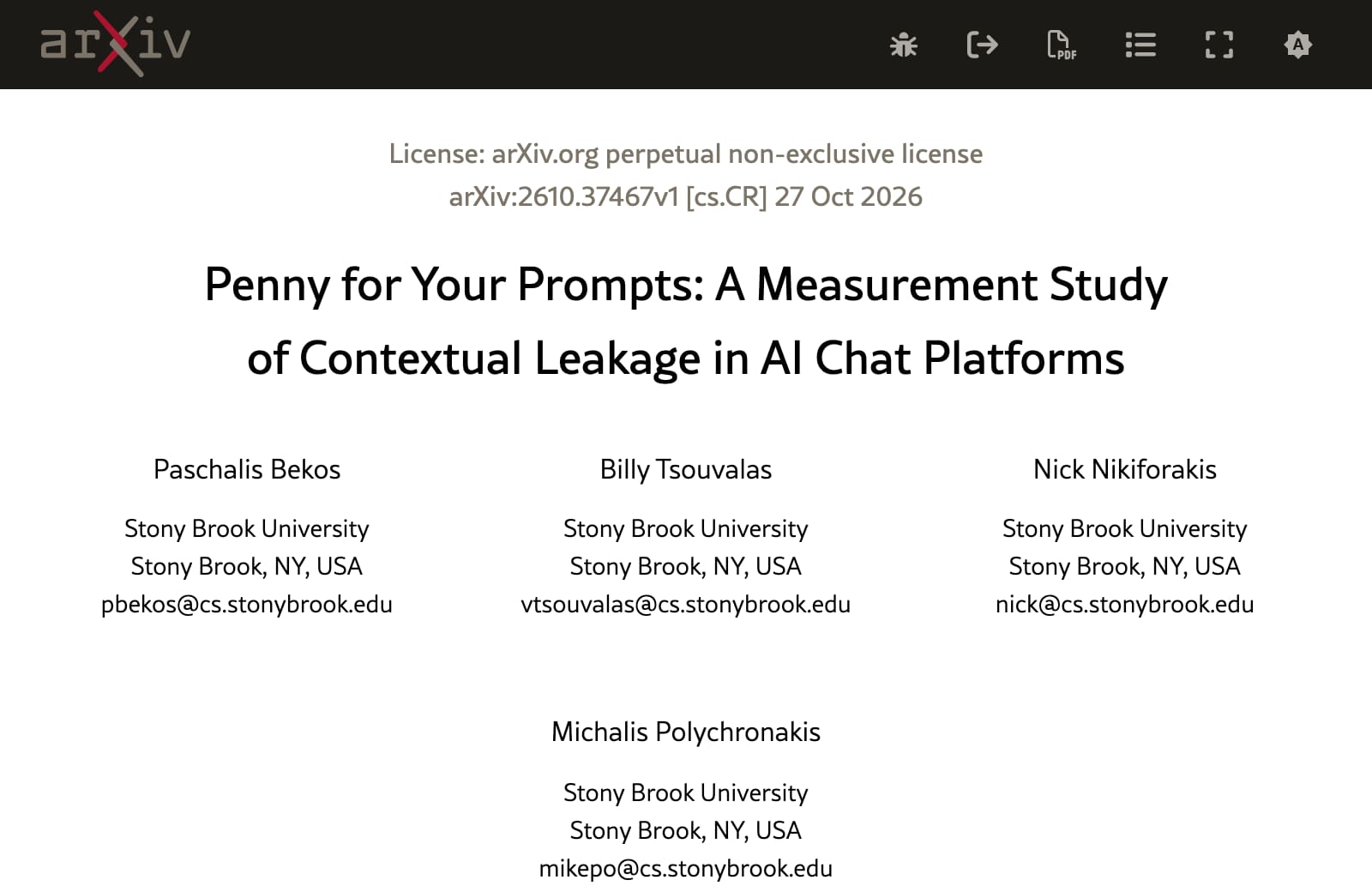
A study of 42 chatbot websites[1] found conversation titles reaching outside trackers on 21 services, and the text of users' prompts on nine. The titles are short summaries of the question that the chatbot sets as the page title, and ordinary website trackers collect page titles automatically. The researchers describe no hacking, and the study did not show that anyone read these conversations or used them for advertising.
- Conversation titles
- 21 of 42 services
- Verbatim prompts
- Nine services
The full story2 more sections
Who is affected
The researchers tested free accounts on the web, from a single US location, with tracking consent accepted, on 6–20 May 2026. They do not establish today's Australian behaviour, paid-tier results or mobile-app exposure.
During testing, the paper records ChatGPT sending conversation titles and the user's email to Google and Meta trackers, and Grok sending titles to Google. The authors say both have since removed those trackers, which they verified before submitting the paper. TheLawGPT, which sent titles and email to Google, also fixed its tracker setup after being told. Claude and Gemini were among the 25 general-purpose services tested. The paper's results do not list either as leaking titles or prompts. See the findings and limitations[1].
For your family, use this as a reason to review what goes into a chatbot. Include the conversations you have on someone else's behalf. Canada's privacy commissioner advises against sharing sensitive or identifiable information[2], including information about other people and children.
Check what each setting controls
OpenAI says it does not share conversations with its marketing partners[3], while acknowledging that it shares certain identifiers and browsing or commercial information to promote its products. That is its published policy, not a response obtained for this story.
Its Marketing Privacy control covers that advertising-related sharing. That is a different thing from the page trackers the study measured, and the study does not say the control stops them. The separate Improve the model for everyone setting[4] concerns model training. Check both rather than treating one privacy switch as a promise covering every use of your information.
Timeline
-
HARD publishes its article, at High.
References5
- ^ Stony Brook University researchers / arXiv (). “Penny for Your Prompts: A Measurement Study of Contextual Leakage in AI Chat Platforms”. Primary findings, methodology, limitations and remediation.
- ^ Office of the Privacy Commissioner of Canada (). “Your privacy and AI chatbots”. Advice to minimise personal information, alter identifying details and protect others' information.
- ^ OpenAI. “How We Promote OpenAI on Third-Party Properties”. OpenAI's stated marketing data practices and Marketing Privacy opt-out.
- ^ OpenAI. “Data controls in ChatGPT”. Purpose and location of model-training controls; availability varies by account.
- ^ Australian Signals Directorate (). “Personal cyber security handbook: Secure your online activity”. Recommends rejecting optional cookies, reputable ad blockers and browsers that enforce privacy.
Situation Room articles are updated as events develop: updates are added to the timeline, and never edited away. Follow them by email or RSS.