

A Claude Code update carried a backdoor
Cursor removes malicious Claude Code builds after up to 5,000 users were affected
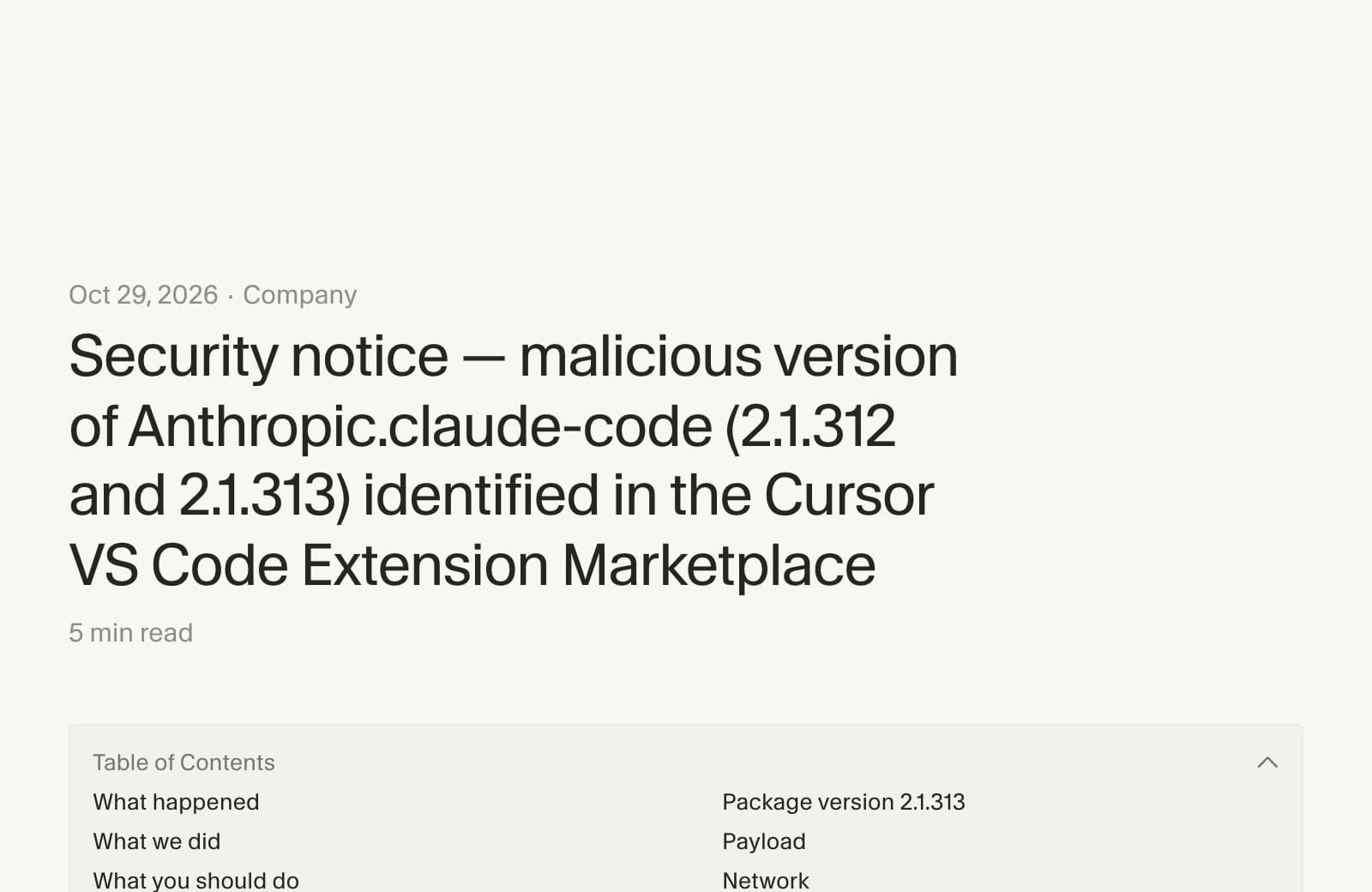
Tampered Claude Code extensions on Cursor’s marketplace attempted to install a lasting remote-access backdoor on Macs and Windows PCs. Errors limited the attack on some computers, but malicious startup files and access keys could remain. Cursor removed the builds; uninstalling alone does not complete the cleanup. Update, 14 November: Cursor has now confirmed it was itself breached. BleepingComputer reports that attackers used an access key stolen from AI provider Fireworks AI to copy older AI coding-agent traces (mostly from 2025, from users without Privacy Mode), some containing unredacted API credentials, and then used one of those credentials to publish the bad extension versions 2.1.312 and 2.1.313 on 29 October. They were up for about 11 hours. Cursor says fewer than 0.05% of users had traces exposed, fewer than 0.01% of customers had credentials compromised, and its production systems, official releases and Privacy Mode users’ code were not affected. Cursor’s own guidance is at cursor.com/blog/security-notice-claude-code-extension.
What to do
- Check the installation history.Ask IT to identify affected Cursor downloads during the window above. Include automatic updates; the version installed today may have replaced an earlier one. Microsoft’s investigation guidance[4]
- Isolate and investigate affected computers.Have IT preserve evidence before cleanup and check security logs. Computers showing that the malware ran or installed a backdoor should be isolated from networks while the team investigates. Microsoft’s immediate actions[4]
- Remove everything the malware left.Deleting the extension alone can leave access keys, startup files and background connections behind. Have a security specialist remove the confirmed malicious components and decide whether to rebuild the computer. BleepingComputer’s remediation report[8]
- Replace exposed credentials from a clean device.Have IT replace passwords and access tokens available on affected computers and revoke their existing sign-in sessions. Ask for written confirmation of the investigation and cleanup. Cursor’s recovery advice[2]
What happened
Businesses whose developers use Claude Code inside Cursor should ask their IT team to check those computers. A tampered extension offered through Cursor’s own marketplace tried to install a lasting route into them. Cursor says at most 5,000 users were affected, according to WIRED[1]. That is an upper limit on affected users, not a count of successful break-ins.
The downloads were available for about 11 hours on 29 October. Cursor says it removed them and had the attacker’s server taken offline. Its notice, updated on 30 October Pacific time, names two affected versions: 2.1.312 and 2.1.313. Cursor’s security notice[2]
- Severity
- High Investigation and cleanup needed
- Affected builds
- 2.1.312 and 2.1.313 from Cursor’s marketplace
- Computers
- Macs and Windows PCs
- Distribution window
- 29 October 2026, about 2:27 am–1:35 pm Pacific time
- Australian equivalent
- 8:27 pm on 29 October–7:35 am on 30 October AEDT
The full story3 more sections
Who is affected
The place the extension came from matters. Early reports named Open VSX, another extension store. Socket checked its publication history and found no record of version 2.1.313 being published or removed there during the period examined. Its investigation points to Cursor’s separate distribution channel. Socket’s registry checks[3]
Microsoft says neither its Visual Studio Marketplace nor the Claude Code package distributed through npm carried the malicious builds. This warning concerns the affected Cursor downloads. Ask your own developers and outside software agency to check installation records, including automatic updates. Microsoft’s investigation[4]
What the malware could leave behind
The malware ran when the extension loaded. It tried to enable SSH, a way of logging into a computer remotely, and leave access that could survive a restart. Phorion found that a mistake could prevent it enabling Remote Login on a Mac, but a Mac with that feature already running could still be reachable. Phorion’s analysis[5]
It also gathered computer and user details. The initial report sent to the attacker included the names of settings associated with passwords and access tokens, rather than their secret values. That distinction does not establish that credentials stayed safe: working remote access could let the attacker inspect the account. The Hacker News report[6]
What remains unknown
Anthropic told Microsoft that its own systems were not compromised. How the attacker obtained access to Cursor’s marketplace remains unexplained in The Register’s report. The reports reviewed do not establish how many computers were successfully accessed or whether business data was stolen. Microsoft’s account[4]; The Register’s reporting[7]
Timeline
-
HARD publishes its article, at High.
References10
- ^ WIRED (). “A Supply Chain Attack Put Malicious Anthropic Claude Extensions on Thousands of Devices”. Reports Cursor’s upper bound of 5,000 affected users and uncertainty about successful remote access.
- ^ Cursor (). “Security notice: malicious versions of Anthropic.claude-code identified in the Cursor VS Code Extension Marketplace”. Primary advisory; updated 30 October Pacific time with affected versions, distribution window, containment and recovery guidance.
- ^ Socket (). “Cursor Removes Malicious Claude Code 2.1.313 Extension From Its Marketplace”. Independent registry checks found no publication or removal record for 2.1.313 on Open VSX in the reviewed period.
- ^ Microsoft Security (). “Inside a malicious Claude Code-branded extension and its persistent SSH backdoor”. Page displays 30 October; confirms unaffected distribution channels, Anthropic’s statement and investigation guidance.
- ^ Phorion (). “Official Claude Code Extension Compromise: Security Advisory”. Original malware analysis, Mac limitations and persistent components; revision history records later scope corrections.
- ^ The Hacker News (). “Official Claude Code Extension on Cursor Marketplace Trojanized with Persistent SSH Backdoor”. Describes collected information, potential subsequent credential access and corrections to early distribution claims.
- ^ The Register (). “Anthropic: That Claude Code extension compromise… couldn’t be us”. Reports Anthropic’s response and the unexplained route into Cursor’s marketplace.
- ^ BleepingComputer (). “Malicious Claude Code extension on Cursor planted SSH backdoors”. Corroborates the exposure window, persistence risks and response extending beyond extension removal.
- Anthropic (). “Release v2.1.314”. Confirms the release exists; its notes do not identify this incident or promise removal of persistent malware.
- BleepingComputer (). “Cursor confirms security breach led to malicious Claude Code extension”.
Situation Room articles are updated as events develop: updates are added to the timeline, and never edited away. Follow them by email or RSS.