

Citi says an AI agent’s payments count as yours
Citi says it will treat payments by an outside AI agent as authorised by the customer
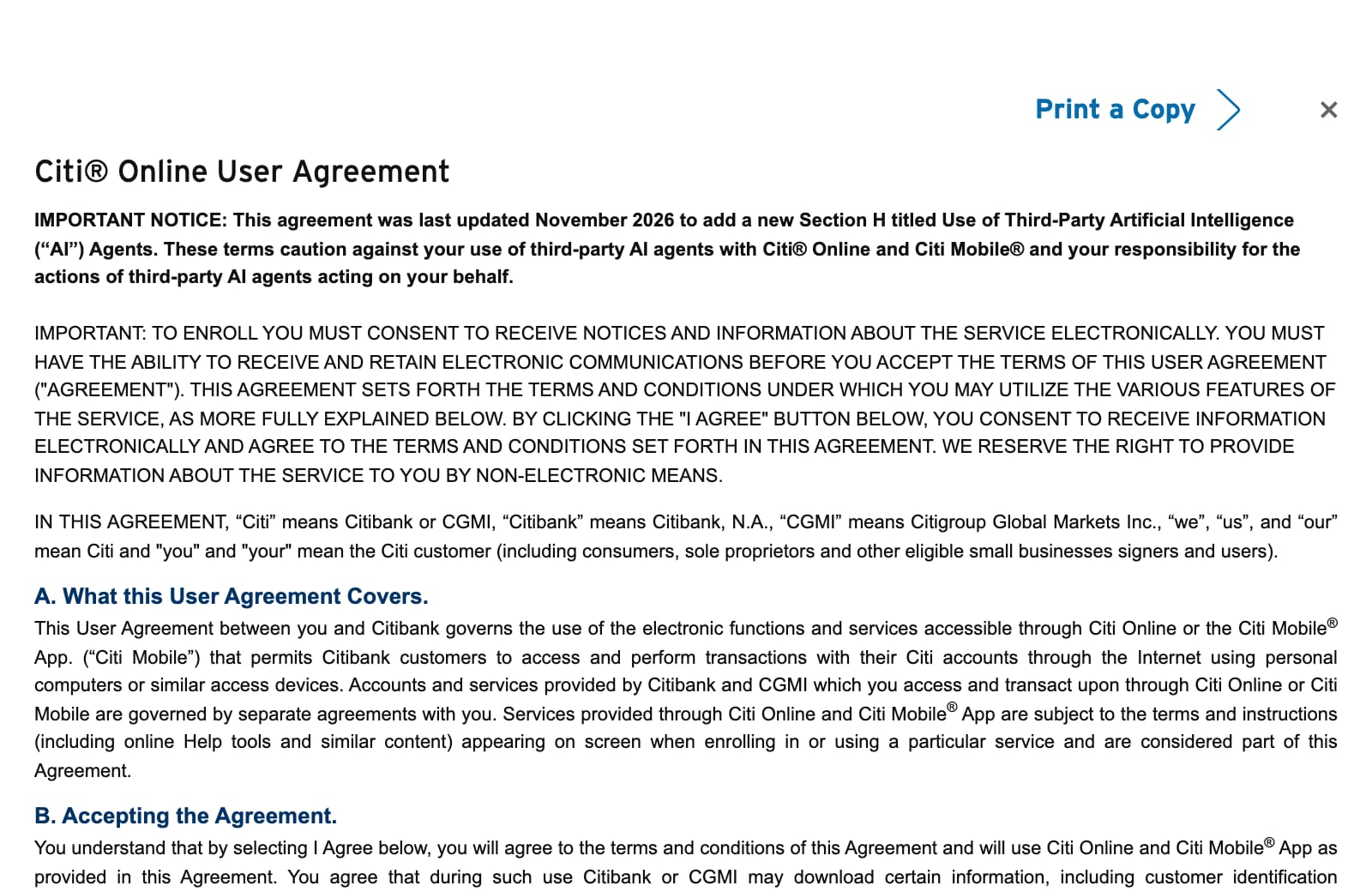
Citi’s November update covers outside AI tools that customers let into Citi Online or Citi Mobile. Citi says it will treat a transfer as authorised even if the agent ignores your instructions. US law can still protect you if someone steals your login from the service and uses it to take money.
What to do
- Ask your bank before you connect an agent.Name the service you want to use. Ask whether it can only read your account or can also move money. Ask who covers a payment it gets wrong and who covers a transfer made with a stolen login.
- Take back access you no longer want.If you gave the service your banking password, change it through your bank’s app or website. Tell the bank you are withdrawing permission and ask it to confirm how to disconnect the service.
- Report a transfer you don’t recognise straight away.Call the number on your card or statement. Give the bank the amount and date, explain what you allowed the agent to do, and ask the bank to investigate. How to dispute an electronic transfer[5]
What happened
If you let an AI assistant into your US Citi account to help with the bills, what happens if it pays one you only wanted it to look up? Under terms Citi added in November, the bank says it will treat that payment as one you authorised. Citi cautions customers against giving an outside AI agent access to their accounts. Citi Online User Agreement, section H[1]
Other US banks have warned customers too. JPMorgan Chase and Bank of America announced similar policies in October. PNC changed its terms on 18 November, according to TechCrunch’s report[2].
- If the agent exceeds your instructions
- Citi says it will count the transfer as yours.
- If someone uses a login the service leaked
- Citi says it will treat that person’s actions as authorised too.
- If Citi supplies the tool in its app or on its site
- Citi excludes it from the new terms for outside agents.
The full story2 more sections
Who is affected
This matters if you give another company’s AI agent, a tool that can act on your instructions, permission to use Citi Online or Citi Mobile. Even asking it to look over your spending involves a privacy decision. Citi says that when you grant access, you give the bank permission to share sensitive information with the agent. Citi’s terms for outside agents[1]
If someone steals your login
Suppose you give a service your banking login and a thief later steals it from that company. Citi says it will treat actions taken with those details as yours. But US law limits how much a customer can lose on certain unauthorised electronic transfers, and a bank cannot take those rights away in its terms. US rules on liability for unauthorised transfers[4]
The US Consumer Financial Protection Bureau gives a specific example. If a thief hacks a company you shared your login with, then uses it to send money from your account without your permission or benefit, the bureau treats that transfer as unauthorised. How quickly you tell the bank can affect how much you get back. The bureau’s guidance on stolen logins[5]
Timeline
-
HARD publishes its article, at High.
References5
- ^ Citi. “Citi Online User Agreement”. The November 2026 notice and section H set out the scope, treatment of leaked logins, privacy terms and exception for tools Citi provides.
- ^ TechCrunch (). “More banks say customers using AI agents are on their own — even if they get hacked”. Citi confirmed the update to TechCrunch, which also reported the timing of the other US banks’ policies.
- ^ Citi. “Agreement for Online Funds Transfers”. Citi explains how it will treat transfers an outside agent initiates, including transfers that exceed the customer’s instructions.
- ^ Consumer Financial Protection Bureau. “Regulation E, section 1005.6. Liability of consumer for unauthorized transfers”. The rule sets liability limits for covered transfers and explains how the timing of a report affects those limits.
- ^ Consumer Financial Protection Bureau. “Electronic Fund Transfers FAQs”. The bureau addresses logins stolen from another company, the duty to investigate reported errors and the rights customers retain under US law.
Situation Room articles are updated as events develop: updates are added to the timeline, and never edited away. Follow them by email or RSS.