

CreditNirvana exposed 6.6 million debt accounts
CreditNirvana fixed flaws that exposed 6.6 million debt accounts and about 315,000 call recordings
The records included credit reports, copies of ID cards and messages between collectors and borrowers. CreditNirvana fixed both flaws in June. The researcher showed what someone could access, but whether anyone stole the records remains unknown.
What to do
- Get the collector’s details.Ask for their name, their company and the amount they say you owe. End the call before making a payment.
- Call your original lender.Use the number on the lender’s official website. Ask whether it hired that collector or sold the debt, and check where any payment should go. The US Federal Trade Commission explains what to ask.[4]
- If you think you paid an impostor, call your bank now.Tell the bank which payment you made and ask whether it can stop the transfer. Moneysmart lists the steps for each payment method.[5]
What happened
Security researcher Eaton Zveare found that someone without a login could listen to about 315,000 recordings in CreditNirvana’s AI call centre. He also found a separate flaw that exposed records for 6.6 million debt accounts across three Indian financial firms. WIRED spoke to Zveare about what he found.[1]
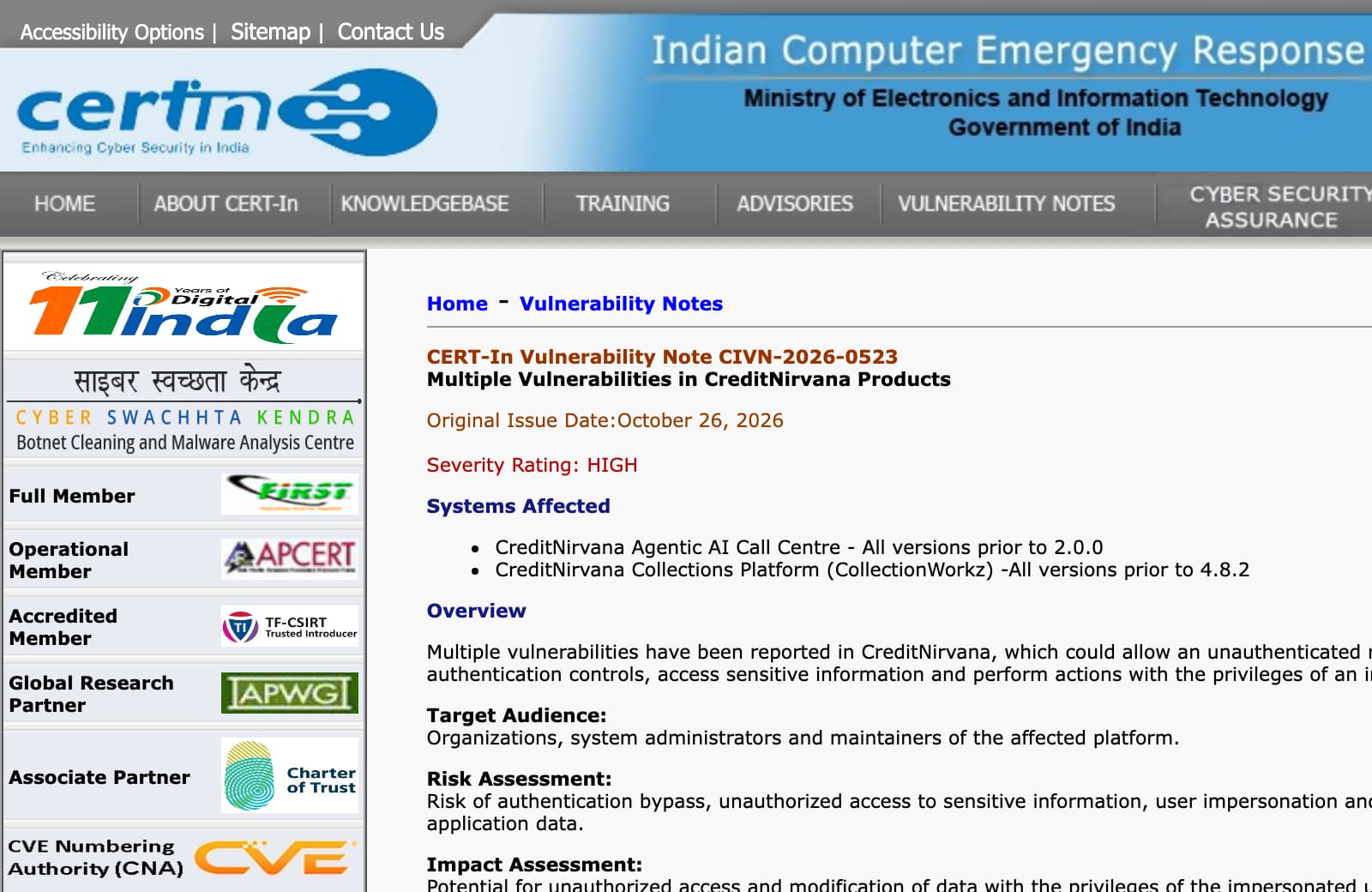
Zveare reported the flaws through India’s Computer Emergency Response Team, known as CERT-In. CreditNirvana fixed both in June. CERT-In published its advisory on 26 October, and Zveare made the scale of the exposure public on 18 November. Whether anyone else took copies remains unknown.
- Call centre
- Agentic AI Call Centre 2.0.0 fixed access to recordings and transcripts (CVE-2026-110474).
- Debt accounts
- CollectionWorkz 4.8.2 fixed a flaw that let an outsider act as a member of staff and read or change records (CVE-2026-110475).
The full story2 more sections
Who is affected
Zveare found about 3.4 million accounts at Aditya Birla Capital Finance. The other 3.2 million were at BharatPe and International Asset Reconstruction Company. The call recordings concerned Aditya Birla Capital Finance customers. The 6.6 million figure counts accounts. The number of individual borrowers remains unknown. Superpower Daily gives the breakdown by company.[3]
What a caller could know
The files included copies of ID cards and credit reports, along with legal papers, emails and texts about collections. In the call centre, someone could read a transcript or listen to the conversation itself. A caller who knew what you had told a collector could sound familiar. You would still need to check who sent them. WIRED describes the records Zveare found.[1]
Timeline
-
HARD publishes its article, at High.
After the news
- Every data breach who was hacked, and how to check if you’re in one
- Data breach settlements the claims open now, by deadline
References6
- ^ WIRED (). “An AI Debt Collection Service Exposed 6.6 Million Accounts and 315,000 Call Recordings”. Reports Zveare’s findings, the June fixes, the kinds of records he found and his work with CERT-In.
- ^ Indian Computer Emergency Response Team (). “Multiple Vulnerabilities in CreditNirvana Products”. Names the researcher, identifies both flaws and lists the fixed version for each product.
- ^ Superpower Daily (). “Researcher discloses AI debt-collection flaws that exposed 6.6 million accounts”. Names the three firms, gives the account totals and identifies which firm the recorded calls concerned.
- ^ US Federal Trade Commission. “Don’t recognize that debt?”. Advises borrowers to identify the collector and check with the original creditor whether it sold the debt or hired that collector.
- ^ Moneysmart (). “What to do if you’ve been scammed”. Advises anyone who paid a scammer to contact their bank immediately and ask it to stop the transaction.
- Reserve Bank of India. “BE(A)WARE”. Advises customers to get contact numbers directly from a bank’s or company’s official website.
Situation Room articles are updated as events develop: updates are added to the timeline, and never edited away. Follow them by email or RSS.