

Molly’s security updates are three months behind
Molly’s three-month update gap raises concern over a fixed Signal calling flaw
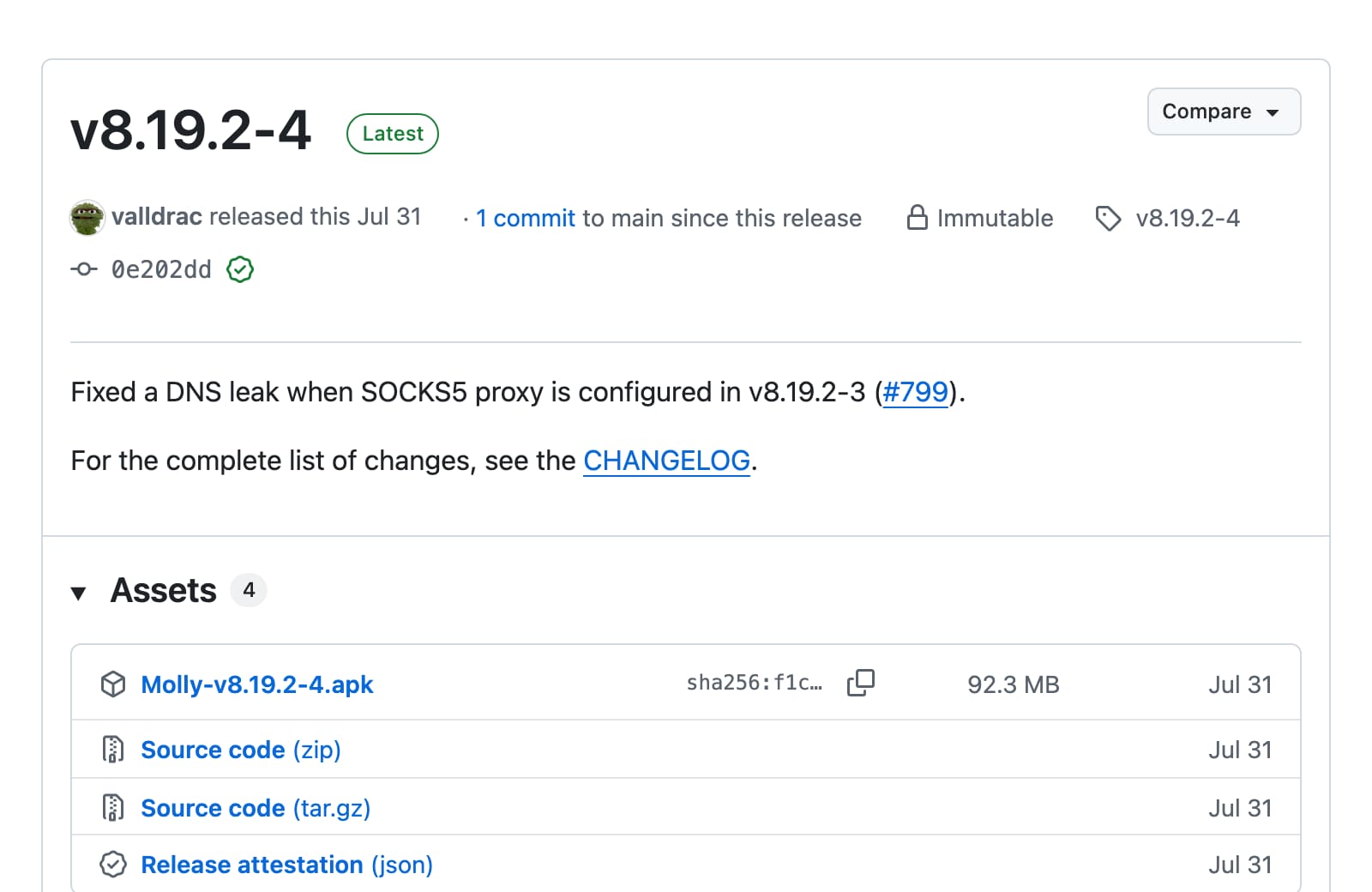
As of 31 October, Molly’s latest listed release is v8.19.2-4, published on 31 July. Its declared calling component predates the fix for CVE-2026-113380, which can leave audio, and possibly video, running after hang-up. We have not verified whether Molly contains an equivalent fix or confirmed attacks against its users.
What to do
- Check Molly’s own update guidance.Start from its official website and release page. Look for an explicit fix or explanation covering CVE-2026-113380. If you help a parent or partner with their phone, check theirs too.
- Use an updated app for calls.Until Molly’s fix is confirmed, HARD recommends avoiding calls through it. Get the latest official Signal app through Signal’s download page[11]. Version 8.27.0 is the Android fix threshold for this flaw, not a reason to install an old release.
- Back up before switching.Create a local chat backup and keep its passphrase somewhere safe. Molly’s documentation says its backups can be restored in Signal[12]. Signal’s backup instructions[13] explain restoring a backup with its 30-digit passphrase before registering the phone number.
- Check the restore before deleting anything.Confirm that the conversations and attachments you need are present. If the backup or restore fails, keep the existing app data and get help before uninstalling Molly or clearing its storage.
What happened
If you use Molly for private calls, check its security guidance before your next one. As of 31 October, the independent Android version of Signal has gone three months without a listed stable release. Its latest release remains v8.19.2-4, published on 31 July[1].
A community post shared on Hacker News[2] warned that Molly had missed security fixes available in Signal. There is a specific reason for concern: Molly’s July release declares an older version of the software that handles calls than the version containing a published security fix. That comparison supports caution, but does not establish whether Molly’s customised version contains an equivalent repair.
- HARD priority
- High Check before making further calls
- Latest listed Molly release
- v8.19.2-4, released 31 July 2026
- Molly’s declared calling component
- RingRTC 2.69.5-1
- Fixed upstream component
- RingRTC 2.72.0
- Official Signal Android fix
- 8.27.0; install the latest available version
- Fixed Molly version
- Not verified
The full story2 more sections
Why the gap matters
The documented flaw concerns the end of a call. Someone on the other end could prevent it from closing properly, leaving audio, and possibly video, running after you press hang up. The CVE record[3] identifies RingRTC versions before 2.72.0 as affected. Signal’s 2.72.0 changelog[4] records the call-ending fix.
Molly’s July release specifies its own RingRTC package numbered 2.69.5-1[5]. We have not independently tested the flaw in Molly or verified an equivalent fix in that package. CISA’s assessment in the CVE record, dated 20 October, recorded no exploitation; that dated assessment cannot rule out subsequent or unreported attacks.
The project has acknowledged its update difficulties. In a 2 October announcement[6], Molly said incorporating Signal’s changes was delaying releases and described a development tool intended to help. Its GitHub security page[7] lists no published advisories, and we could not verify a fixed Molly release.
Who is affected
The immediate concern is people making calls through Molly on Android[8], including anyone whose phone you help manage. Check which app is actually installed. For people using official Signal, Italy’s government security advisory lists Android versions before 8.27.0 as affected[9]; Signal’s 8.27.0 source includes the fixed calling component[10].
Timeline
-
HARD publishes its article, at High.
References14
- ^ Molly (). “Molly v8.19.2-4 release”. Latest-labelled stable release, its version and publication date.
- ^ Hacker News (). “Molly (Signal fork) has not been updated since 3 months and is vulnerable”. Discussion linking to the supplied PieFed warning; establishes the news trigger, not technical confirmation.
- ^ CVE Program (). “CVE-2026-113380 record”. Affected RingRTC range, call-ending impact and CISA’s dated exploitation assessment.
- ^ Signal. “RingRTC v2.72.0 changelog”. Vendor changelog records the repair for calls failing to terminate completely.
- ^ Molly. “Molly v8.19.2-4 dependency versions”. The tagged release declares im.molly:ringrtc-android:2.69.5-1.
- ^ Molly (). “Molly’s announcement about delayed updates”. Indexed official profile contains the dated announcement attributing delays to incorporating Signal changes.
- ^ Molly. “Molly security overview”. No published GitHub security advisories were listed when checked.
- ^ Molly. “Molly homepage”. Identifies Molly as an independently maintained Signal fork for Android.
- ^ CSIRT Toscana / CSIRT-ITA (). “Signal RingRTC vulnerability advisory AL03/261020/CSIRT-ITA”. Government advisory lists affected versions, including Signal Android before 8.27.0, and recommends updating.
- ^ Signal. “Signal Android v8.27.0 dependency versions”. Confirms that Signal Android 8.27.0 includes RingRTC 2.72.0.
- ^ Signal. “Download Signal”. Official route to Signal’s mobile downloads.
- ^ Molly. “Molly documentation: compatibility and backups”. Project documentation states that Molly backups can be restored in Signal.
- ^ Signal. “Backup and Restore Messages”. Explains local backup preservation, the 30-digit passphrase and restoration before registration.
- PieFed user beep / SDF Chatter. “Federated copy of the PieFed Molly warning”. Indexed copy reproduces the warning’s body, July release claim and reference to the Signal 8.27 fix.
Situation Room articles are updated as events develop: updates are added to the timeline, and never edited away. Follow them by email or RSS.