

A hijacked Convertr script stole shoppers’ card details
Hijacked Convertr analytics script stole card details; researchers confirm removal
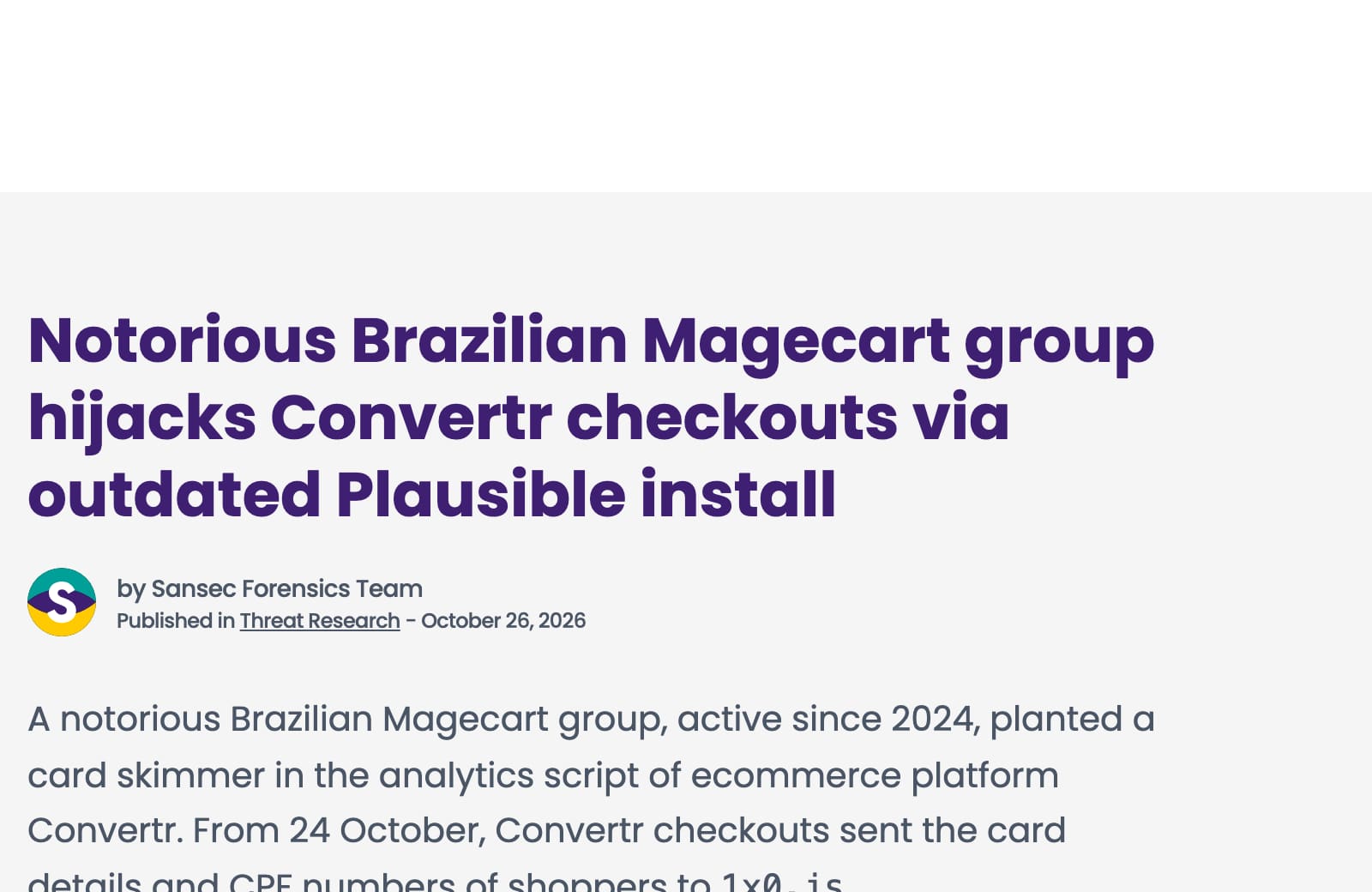
The code targeted card numbers, expiry dates, security codes, names and Brazilian taxpayer numbers. Sansec warns that browsers could retain infected copies for up to 24 hours after cleanup.
What to do
- Contact your bank if your card may be exposed.Sansec recommends blocking and replacing cards used from 24 October at Brazilian stores whose payment-page address contained checkout.convertr. Use your bank’s app or the number on your card. Do not wait for a merchant’s notification if your purchase fits that description.
- Check card activity.Review payments with any parent whose shopping you help manage. Report unrecognised transactions promptly and keep the bank’s reference number. Transactions can take days to appear. Moneysmart explains what to check[6].
- Clear cached files before returning to an affected checkout.Wait for the merchant to confirm cleanup, then clear your browser’s cache before shopping there again. This addresses retained copies of the script; it cannot recover details already stolen.
- Ask your business’s checkout provider for answers.If it uses Convertr, request written confirmation of whether your checkout was exposed, the affected dates and the cleanup. Ask how affected customers will be notified, and inform your payment provider.
What happened
Shoppers who paid through affected Convertr checkouts from 24 October should contact their bank. Security firm Sansec found card-stealing code inside a shared analytics script used by the Brazilian online-store platform. The theft happened during checkout. Sansec’s investigation[1] explains what it found.
On 27 October, Sansec confirmed that the script was clean. It says Convertr had also upgraded its analytics software to a patched version and was notifying affected merchants, payment providers and authorities.
- HARD rating
- High
- Data targeted
- Card number, expiry date, security code, cardholder name and CPF, Brazil’s taxpayer number
- First detected
- 24 October 2026
- Residual risk
- Sansec warns that browsers could retain the infected script for up to 24 hours after cleanup
The full story2 more sections
Who is affected
Convertr serves dozens of Brazilian fashion brands. The concern is card payments through their Convertr checkouts from 24 October. The reports do not say how many shoppers lost data; making a purchase during that period does not prove your details were taken. CZR Security’s report[3] also makes that distinction.
A known flaw is suspected
Convertr hosted its own copy of Plausible, the analytics software. Sansec suspects attackers entered through CVE-2026-8467, but has not seen the server logs needed to confirm that. The entry point remains unproven.
Plausible’s release notes[4] identify Community Edition versions 3.0.0 through 3.2.0 as vulnerable and 3.2.1 as fixed. The flaw allows someone without a login to run code on the affected service. If your business hosts Plausible itself, ask its administrator to update affected installations and investigate signs of compromise, following the vendor’s advisory[5].
Timeline
-
HARD publishes its article, at High.
After the news
- Every data breach who was hacked, and how to check if you’re in one
- Data breach settlements the claims open now, by deadline
References6
- ^ Sansec (). “Notorious Brazilian Magecart group hijacks Convertr checkouts via outdated Plausible install”. Original investigation, updated 27 October with cleanup confirmation, notifications and precautions.
- ^ BleepingComputer (). “Hackers hijack Convertr analytics script to steal payment card data”. Reports the incident, targeted fields, cleanup and browser-cache precautions.
- ^ CZR Security (). “Ataque Magecart compromete checkouts de lojas brasileiras e coloca dados de cartões e CPF em risco”. Portuguese coverage distinguishes potential exposure from proven individual theft; relies on Sansec.
- ^ Plausible (). “Plausible Community Edition v3.2.1”. Official security release lists affected versions and the 3.2.1 fix.
- ^ Plausible (). “Plausible Community Edition security advisory GHSA-mhcv-h7gf-57cf”. Confirms the flaw, affected versions, fixed version and investigation guidance.
- ^ ASIC Moneysmart (). “Bank transaction problems”. Supports transaction checks, prompt bank contact and retaining a reference number.
Situation Room articles are updated as events develop: updates are added to the timeline, and never edited away. Follow them by email or RSS.