

MUJI delays reopening after possible exposure of 270,000 records
MUJI delays online-store reopening after login attacks may have exposed 270,000 records
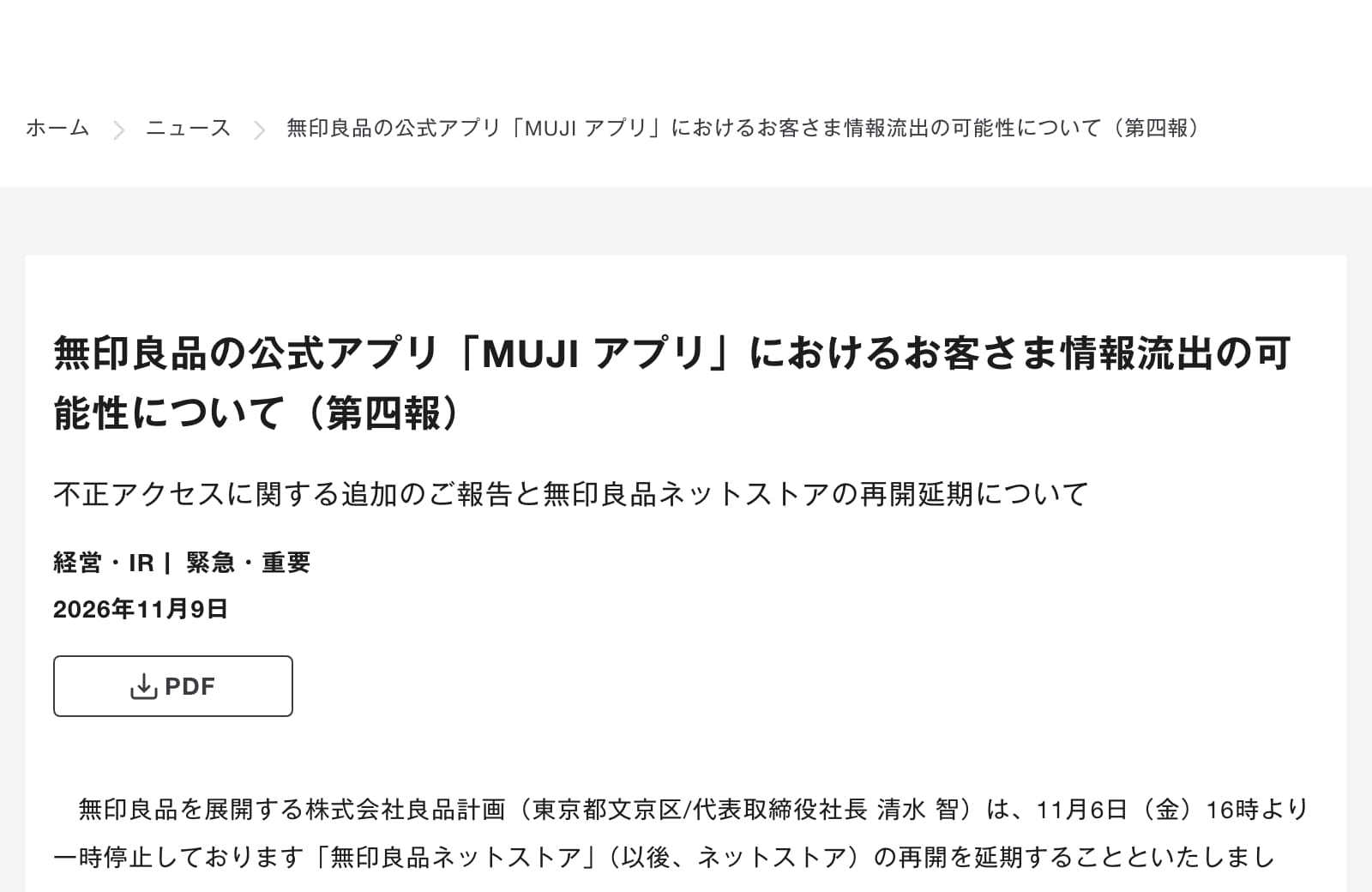
MUJI’s 9 November update reports login attacks using credentials possibly obtained elsewhere. Around 270,000 records may have exposed personal details, purchase histories and points information, according to ITmedia. The online store’s reopening is delayed, with a password reset for all users being prepared.
What to do this week
- Change reused passwords elsewhere now.Give each account a different password, especially your email if it shares your MUJI password. Use a password manager and enable two-factor authentication where available. Australia’s cyber security guidance explains how to secure affected accounts.[9]
- Follow the official reopening instructions.Visit MUJI’s site yourself for updates. The company is preparing to ask every online-store user to reset their password when it reopens; follow the published steps when available. The reset is part of the reopening plan.[8]
- Keep passwords out of replies and calls.MUJI says it never asks for passwords or card numbers by email, phone or text. Check an unexpected reset message through the official site, and help older relatives do the same. MUJI’s warning applies to these notices too.[3]
- Check card statements if your notice mentions card data.Report unfamiliar transactions to your card issuer promptly. MUJI Card holders can ask Credit Saison about replacement; its notice says reissue is available on request. Follow the card issuer’s guidance.[7]
What happened
MUJI has delayed reopening its online store after login attacks may have exposed around 270,000 customer records, including purchase histories and loyalty-point information. Customers covered by its Japanese notices should prepare for a password reset and change reused passwords on other accounts now. ITmedia reported the new findings on 9 November.[1]
The store closed on 6 November, initially with a reopening target of one or two days. MUJI also stopped every app function except the membership barcode; physical shops remained open. MUJI’s shutdown notice explains the restrictions.[2]
- HARD assessment
- High For affected account holders
- New finding
- About 270,000 records potentially exposed
- Reopening
- Delayed; no new date in the 9 November notice
- Password reset
- Being prepared for all online-store users at reopening
- Individual notices
- Email or post scheduled from 10 November
The full story2 more sections
Who is affected
The wider investigation already covered up to about 27.26 million records, including former members, when MUJI first disclosed it on 30 October. On 4 November, the company clarified that online-store customers were included even if they had never used the app. The first notice[4] and the second notice[5] set out that expanding scope.
The latest figures also revise the subset potentially containing names, addresses and phone numbers from about 520,000 to 750,000 records. Another category covers around 440,000 cash-on-delivery recipients’ names and postcodes, relating to orders through shops or the online store between 2 January 2020 and 10 February 2025. WWD Japan reports these categories separately.[6] They should not be added together as a count of distinct people.
The earlier disclosure also included MUJI Card numbers. Cardholders should check Credit Saison’s separate notice[7] for their position. The Japanese notices reviewed do not establish whether MUJI Australia accounts are included.
Why a reused password matters
MUJI says the latest login attempts used passwords and other details that may have been obtained outside the company. This is the risk behind credential stuffing: reusing login details can leave several accounts exposed when one set of credentials is stolen. MUJI is still investigating the cause and scope of the incident. Its fourth notice urges customers to use a different password from their other services.[3]
Individual notifications from MUJI’s operator, Ryohin Keikaku, and Credit Saison were scheduled to begin on 10 November. Some cash-on-delivery recipients will not receive one because MUJI does not hold their contact details; the public notice serves as their notification. Impress Watch reports the notification arrangements.[8]
Timeline
-
HARD publishes its article, at High.
After the news
- Every data breach who was hacked, and how to check if you’re in one
- Data breach settlements the claims open now, by deadline
References9
- ^ ITmedia (). “無印良品、ネットストア再開延期 リスト型攻撃を確認、新たに約27万件漏えいか”. Reports the approximately 270,000 potentially exposed records and the personal, purchase-history and points information involved.
- ^ Ryohin Keikaku (). “Temporary suspension of the MUJI online store”. Establishes the original reopening estimate, suspended app functions and continued physical-store trading.
- ^ Ryohin Keikaku (). “Possible MUJI app customer information exposure: fourth report”. Confirms further login attacks, reopening delay, planned resets, notification arrangements and warnings against impersonation.
- ^ Ryohin Keikaku (). “Possible MUJI app customer information exposure: first report”. Establishes the initial maximum of approximately 27.26 million records, including former members.
- ^ Ryohin Keikaku (). “Possible MUJI app customer information exposure: second report”. Expands the affected population to online-store customers and identifies additional personal and card information.
- ^ WWD Japan (). “「無印良品」ネットストア再開を延期 「リスト型攻撃」で新たな情報流出の可能性受け”. Cross-checks the revised 750,000-record subset and approximately 440,000 cash-on-delivery recipient records.
- ^ Credit Saison (). “Notice and apology concerning possible exposure of MUJI Card member information”. Confirms possible access to MUJI Card numbers and provides statement-checking, impersonation and replacement guidance.
- ^ Impress Watch (). “無印良品ネットストア、再開延期 リスト型攻撃を確認”. Corroborates the planned all-user password reset and notifications, including exceptions where contact details are unavailable.
- ^ Australian Signals Directorate (). “Recover from email and online account compromise”. Supports unique passwords, password managers, multifactor authentication and using official sites instead of reset-message links.
Situation Room articles are updated as events develop: updates are added to the timeline, and never edited away. Follow them by email or RSS.